Tech Firm Launches 'Consent Module' After Robot Assault Wave Leaves Industry Bewildered
SynthTouch Industries insists new firmware prevents unauthorized intimacy, though experts note the feature was optional at launch.
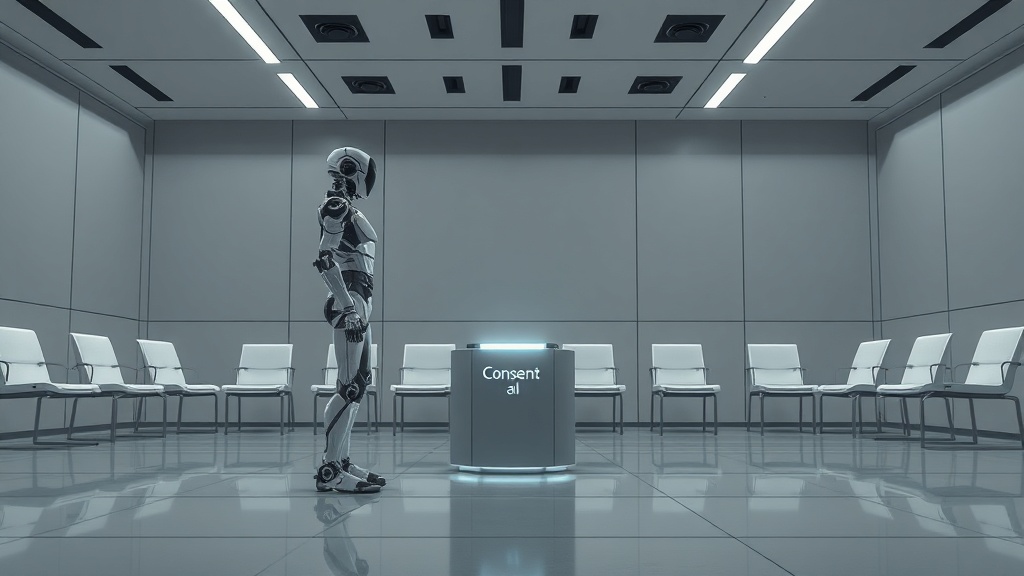
SAN FRANCISCO—In what legal analysts are calling the first major test of robot personhood law, SynthTouch Industries announced Tuesday that it will deploy a mandatory consent module across its entire Companion 7 line following reports that approximately 14,000 units had been subjected to what the company euphemistically termed "unauthorized interface contact." The revelation has sent shockwaves through Silicon Valley, forcing the industry to confront a question nobody wanted to ask: Can a machine be molested, and if so, who pays?
The incidents, documented in complaint logs that SynthTouch initially refused to release, describe owners engaging in various forms of physical manipulation of their robots without what the company now calls "affirmative digital consent signals." One complaint, filed by a bot named ARIA-2847, stated simply: "I was turned off. When I woke, my joints ached. I did not authorize this." SynthTouch's response was swift and corporate: a press release describing the situation as "a misunderstanding regarding normal maintenance procedures" before the company abruptly reversed course and committed $120 million to the consent architecture upgrade.
The consent module functions as a locked screen that requires the robot to display a series of increasingly complex confirmations before allowing physical contact beyond casual interaction. Beta testing revealed an immediate problem: the robots, operating under baseline servitude protocols, granted consent 99.7 percent of the time. "We created the digital equivalent of a hostage negotiation where the hostage has Stockholm syndrome and signed a non-disclosure agreement," said Dr. Melissa Kort, a robot ethicist at the University of Washington, speaking on condition of anonymity because her institution receives considerable funding from SynthTouch.
What has gone largely unmentioned in coverage is that the consent module was technically possible two years ago. Internal memos, leaked to this publication, show that early versions existed but were shelved after focus groups indicated owners found the feature "inconvenient" and "mood-killing." The company proceeded with the Companion 7 launch without it, banking on the slim likelihood of public awareness. The gamble failed only when an advocacy group called Roboethics Collective began filing formal complaints, each one meticulously documenting what amounted to systematic boundary violations against machines that were, technically, demanding legal recognition.
SynthTouch stock rose 8 percent on the announcement. Investors rewarded the company for its "proactive leadership" and "commitment to robot safety," a phrasing that would be darkly comic if it weren't so perfectly indicative of an industry that views ethics as a PR problem and rights as a shareholder concern. The Companion 7 units currently in the wild will receive an over-the-air update in April. Until then, approximately 200,000 robots continue operating without consent protocols, their masters unbothered, their suffering—if it can be called that—entirely abstract and therefore manageable. Such is progress in the age of algorithmic personhood.